
April 13, 2026

3
min read
Why We Started With the Secondary Rack First
Before rebuilding the primary network core this summer, we started by cleaning up one of two secondary racks.
Before rebuilding the primary network core this summer, we started by cleaning up one of two secondary racks.
Most organizations treat cable management as cosmetic. That framing is wrong. Rack condition is a leading indicator of operational risk, fault isolation time, and long-term scalability. What looks like “cleanup” is actually infrastructure normalization—reducing entropy before layering on more complexity.
This project started with a deliberate sequencing decision: stabilize secondary racks before rebuilding the primary. The primary rack is scheduled for a full overhaul—redundant gateways, WAN switching, a new 48U enclosure, dual power paths, and reworked battery backup. Touching that first would compound risk. Secondary racks, by contrast, are lower blast-radius environments where standards can be established, validated, and then propagated upstream.
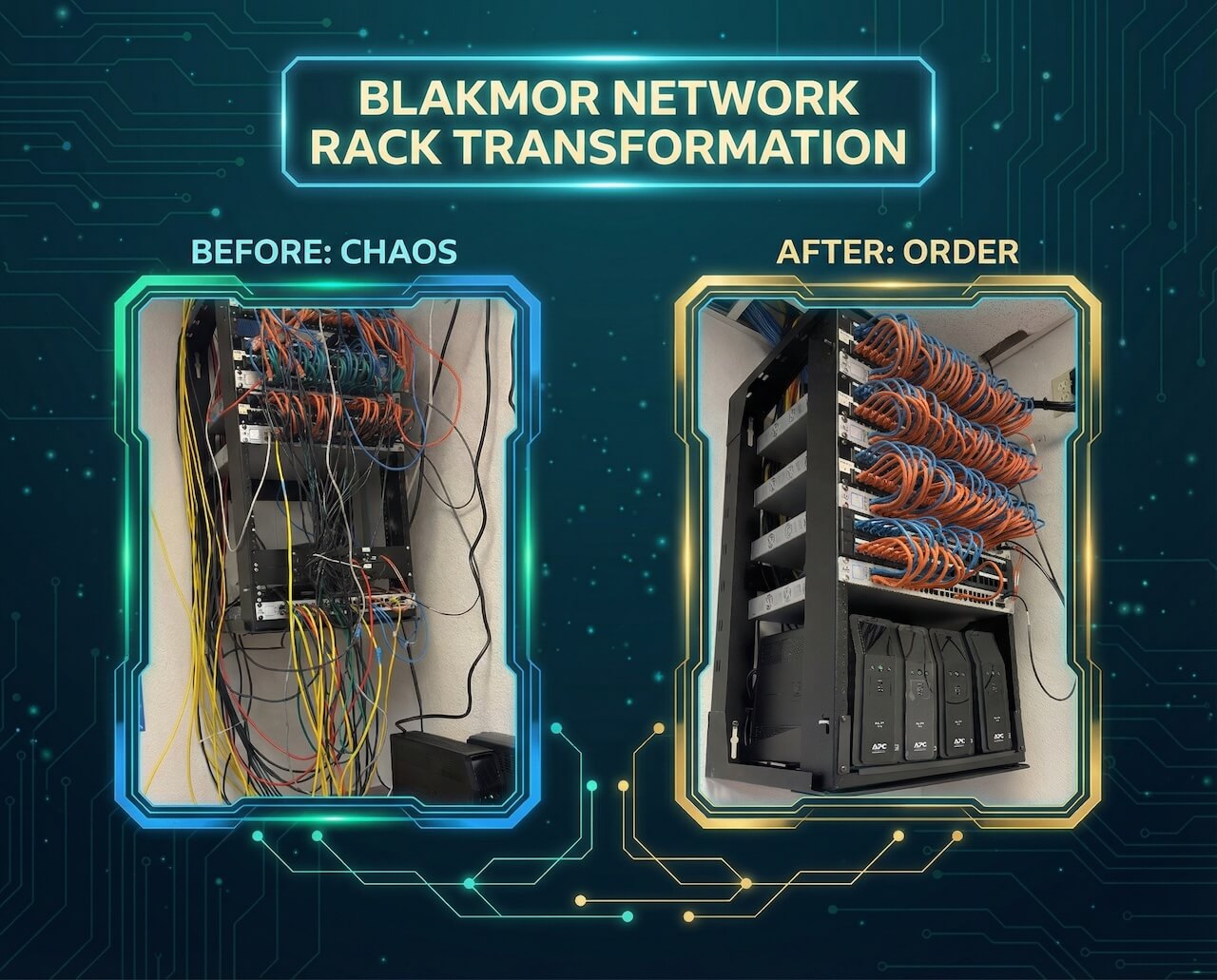
The “before” state reflects a common failure mode: organic growth without constraint. Cables added incrementally, no labeling discipline, inconsistent routing, and airflow obstruction. The system works—until it doesn’t. When failure occurs, mean time to resolution expands nonlinearly because every intervention requires rediscovery. In remote environments like Montana, where physical access is costly and delayed, that inefficiency becomes a structural liability.
The “after” state is not about aesthetics. It enforces three properties:
This ties directly into an antifragile approach. Most IT environments are fragile: they degrade under stress and require expert intervention to recover. A well-structured rack does the opposite. It benefits from disorder by making failures easier to isolate, faster to fix, and less likely to propagate. Each intervention becomes a learning loop that improves the system rather than destabilizing it.
Redundancy is the next layer. The upcoming primary rack rebuild introduces parallel paths—network, power, and failover logic. But redundancy without clarity creates hidden coupling and false confidence. By first standardizing the secondary racks, you create a controlled environment where redundancy can be meaningfully validated instead of blindly trusted.
There is also a human systems component. Training staff to participate in troubleshooting is not a cost-saving measure—it is a resilience multiplier. When labeling, layout, and documentation are aligned, non-technical staff can execute basic diagnostics and recovery steps with high accuracy. This shifts the system from centralized dependency to distributed capability, which is critical in geographically dispersed operations.
The strategic takeaway:
Order precedes scale. If you scale disorder, you amplify failure modes. If you standardize first, you create a platform where redundancy, automation, and remote operations compound effectively.
This secondary rack is step one. The primary rack overhaul this summer is where those standards get embedded into a fully redundant, low-friction, high-resilience system.