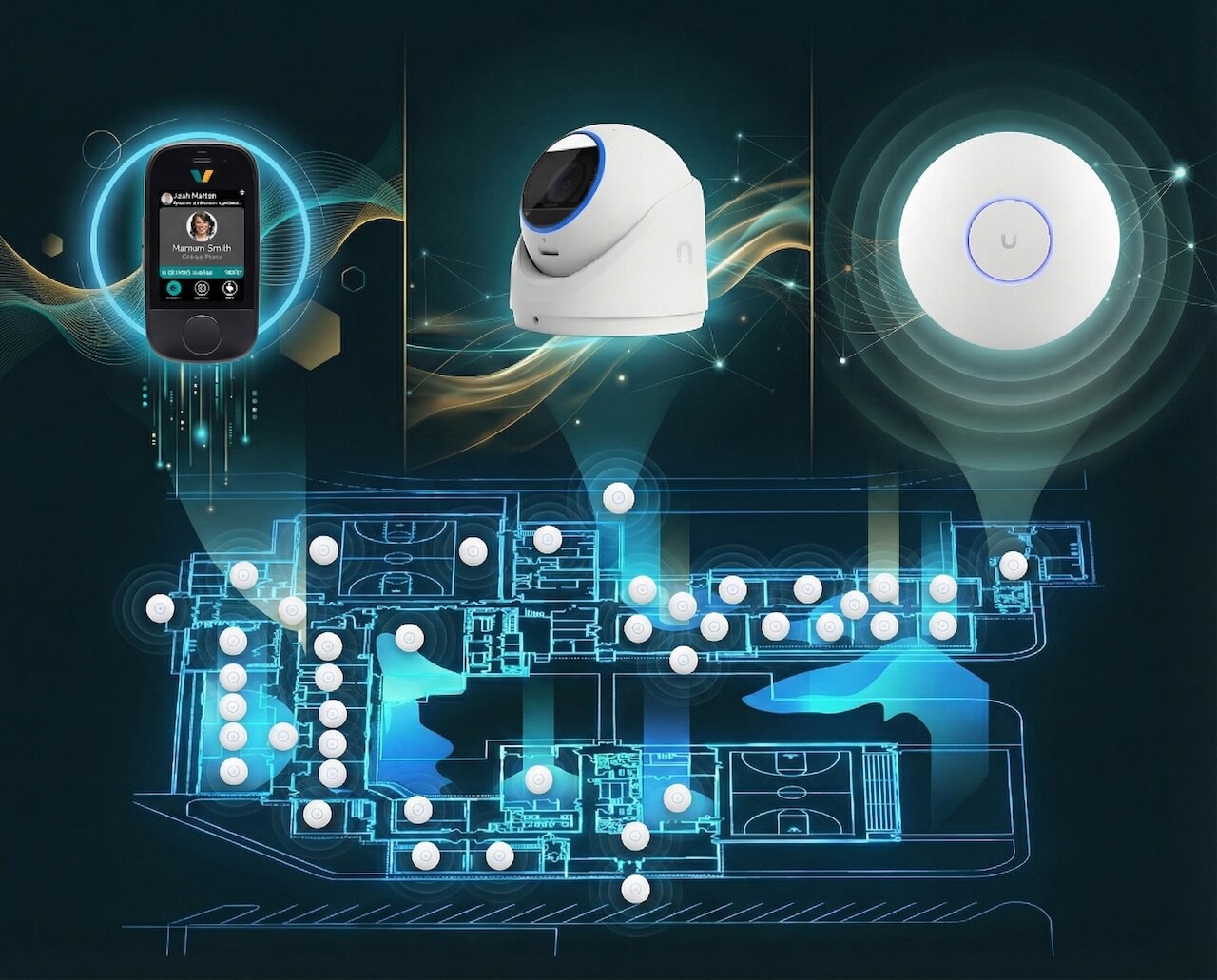
A school campus recently undertook a full overhaul of its communications and safety infrastructure, driven by the deployment of Stryker Vocera—a real-time, voice-based communication system designed for high-stakes environments where reliability is non-negotiable. Unlike typical Wi-Fi use cases, this system operates as part of the school’s emergency response layer, requiring deterministic wireless performance, seamless roaming, and full campus coverage with no dead zones.
The existing wireless network was not designed for this class of workload. Vocera relies on access point proximity to determine staff location in real time, meaning coverage density is not just about signal strength—it directly impacts system accuracy and functionality. To meet this requirement, the network was redesigned using a 1:1 access point deployment strategy across key areas of the campus. While this approach is typically avoided due to the risk of co-channel interference and unnecessary hardware overhead, it was the correct decision here given the system’s dependency on precise location mapping.
Executing this properly required disciplined RF engineering. A full wireless spectrum analysis was conducted prior to deployment to map environmental interference, identify optimal channel allocations, and ensure clean airtime across the network. Channel planning was tightly controlled to avoid overlap and contention, especially critical in a dense deployment model. The result is a network that delivers both high availability and the deterministic performance required for real-time voice communication.
The physical infrastructure presented its own constraints. Prior installations by other contractors had not followed code, with low-voltage cabling loosely laid across drop ceiling grids. This creates both operational risk and long-term fragility—any technician working above the ceiling is one accidental step away from taking down critical systems. All cabling for this project was re-run and secured to code, improving not just reliability but safety and maintainability for anyone interacting with the building infrastructure going forward. New cable drops were installed where needed to support proper access point placement and eliminate prior coverage gaps.
Despite inheriting the project midstream after another contractor exited, the full wireless deployment—spanning approximately 50 access points—was completed on an accelerated timeline. Close coordination with the Stryker team ensured that system-specific performance requirements were validated throughout the process. In parallel, SIP trunk integration is being implemented to support outbound emergency communication, extending the system’s capability beyond internal coordination to external response.
Alongside the communications overhaul, the school’s security infrastructure was modernized. A failing camera system was replaced with 24 new high-definition cameras, paired with a new network video recording platform. The upgraded system provides significantly improved coverage, faster access to footage, and intelligent detection capabilities that reduce the time required for administrators to review incidents. Cloud-based access allows authorized staff to securely review footage from anywhere, removing prior bottlenecks tied to on-site systems.
Network resilience was also addressed at the core. The existing firewall and gateway—already exhibiting intermittent failures—were replaced with a new redundant gateway architecture featuring automatic failover. This eliminates a major single point of failure and ensures continuity of operations during outages. The system is now designed with resilience as a baseline rather than an afterthought.
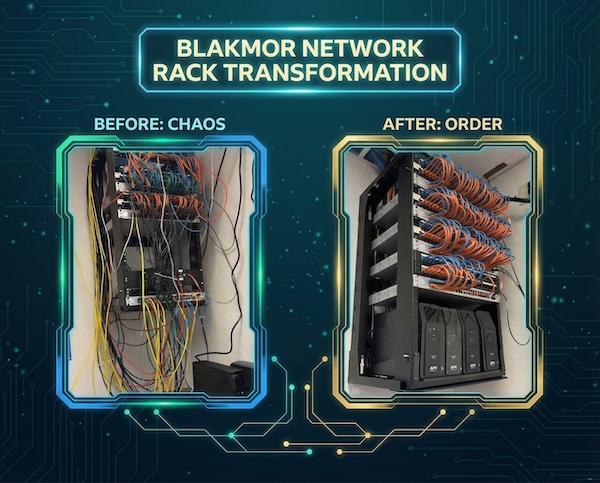
This work is part of a broader, phased modernization effort. Earlier progress on infrastructure cleanup can be seen in the secondary rack overhaul, documented in this breakdown of why we started with the secondary rack first. That initial phase focused on restoring order and creating a stable foundation for the more complex systems now being layered on top.
Looking ahead, additional phases are already planned. These include the replacement of another 24 cameras to complete campus-wide coverage, continued rack remediation, and further investment in core infrastructure resilience. Upcoming upgrades will introduce switch aggregation, redundant power supplies, properly sized battery backup systems, and expanded power-over-ethernet capacity to support future devices and systems without requiring rework.
From a systems perspective, the key outcome is not just improved performance—it is optionality. The campus now has a communications and infrastructure layer that can reliably support safety systems, scale with future demands, and tolerate failure without operational disruption. This shifts the environment from a fragile, reactive posture to one that is structured, resilient, and capable of compounding value over time.